


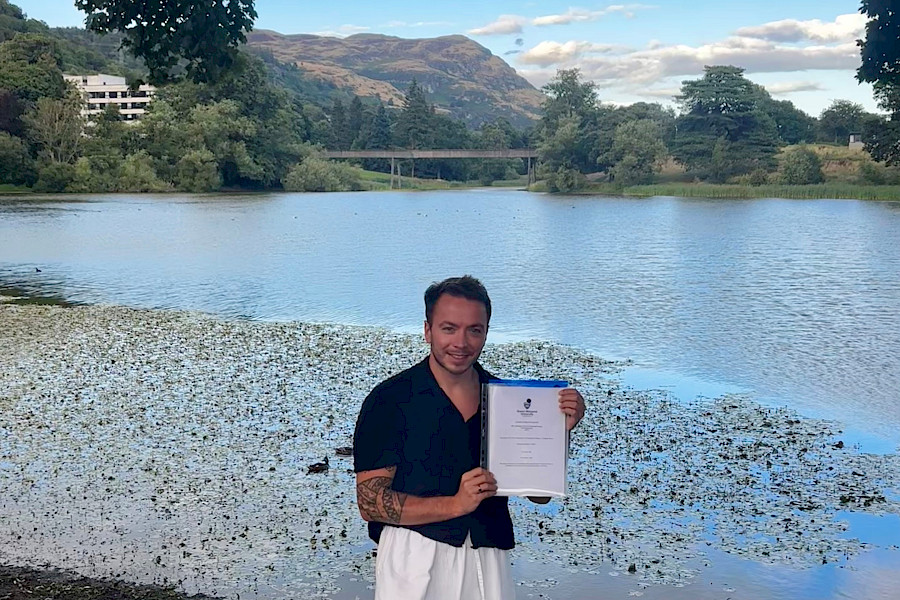

In a previous blog, I shared that my MSc dissertation research was underway, exploring the therapeutic use of trampolines in Occupational Therapy. I am now pleased to share that this dissertation has been completed and submitted.

The dissertation, titled “Therapeutic use of the trampoline in Occupational Therapy: A Scoping Review”, set out to map and describe the existing literature on how trampolines are used therapeutically, and to consider what this might mean for Occupational Therapy practice.
For nine years, I have seen first-hand the potential of trampoline-based activity for movement, confidence, play, participation and joy. Submitting this dissertation feels like an important step in moving that practice-based knowledge into a stronger academic space, helping to pioneer the development of an evidence base for this work within occupational therapy
This has been a meaningful piece of work for me, both professionally and personally. As the founder of BounceOT, I have seen how trampoline-based activity can create opportunities for movement, play, confidence, communication, participation and enjoyment. However, as Occupational Therapists, we also have a responsibility to look beyond what appears valuable in practice and ask important evidence-informed questions.
What evidence currently exists?
How is trampoline-based therapeutic activity described?
Who is it being used with?
What outcomes are being reported?
Where are the gaps?
And how might this inform safe, purposeful and occupation-focused practice?
These were some of the questions that shaped the dissertation.
Why This Research Was Needed
Innovation in practice often happens before the evidence base has fully caught up. New approaches can emerge from practitioner observation, service-user feedback, family experience and real-world practice. This is often where exciting developments begin.
However, within health and social care, promising innovations need to be critically examined. It is not enough for an approach to feel meaningful or to be valued locally. Occupational Therapy is an evidence-informed profession, and our clinical reasoning should be shaped by the best available evidence, professional expertise, ethical practice and the values and priorities of the people we work alongside.
This was the starting point for the dissertation: the tension between practice-based innovation and evidence-informed accountability.
Trampoline-based therapeutic activity is not new. It has been used across different settings, including health, education, rehabilitation, community provision, disability sport and leisure-based contexts. It may be described using a range of terms, including rebound therapy, trampoline therapy, therapeutic trampolining, trampoline exercise or trampoline-based activity.
This variation in language matters. If similar practices are being described differently across different disciplines and settings, the evidence becomes harder to locate, compare and understand. It also means that the Occupational Therapy contribution may be present in practice, but not always clearly visible within the published literature.
Looking Through an Occupational Therapy Lens
A key part of the dissertation was considering trampoline-based therapeutic activity through an Occupational Therapy lens.
For Occupational Therapists, the trampoline is not simply a piece of exercise equipment. It may provide a sensory-rich, motivating and adaptable activity context. It may support play, movement, regulation, interaction, confidence, communication, participation and engagement. It may also offer a way for children, young people or adults to access meaningful physical activity in a way that feels enjoyable and purposeful.
However, this does not mean we can automatically assume effectiveness. Occupational Therapy relevance is not the same as strong evidence. This distinction was important throughout the dissertation.
The aim was not to prove that trampoline-based activity works. Instead, the purpose was to map what is currently known, describe how the activity is being used and understood, and identify where further research and clearer guidance may be needed.
Why a Scoping Review?
A scoping review was chosen because the topic is broad, developing and spread across different disciplines. Rather than focusing on one specific intervention, diagnosis or outcome, the review explored the wider landscape of evidence.
This approach allowed the dissertation to consider academic literature alongside relevant grey literature, such as professional guidance, service information and practice-based sources. This was important because trampoline-based therapeutic activity appears to be an area where practice may be developing ahead of formal research.
By mapping the literature in this way, the dissertation aimed to support a more informed conversation about how trampoline-based therapeutic activity is currently described, implemented and evaluated, and where Occupational Therapy might contribute to future evidence development.
A Starting Point, Not the Final Word
Submitting this dissertation feels like an important milestone, but it is also only the beginning of a wider conversation.
The therapeutic use of trampolines is an area with exciting potential, but it also requires careful thinking, clear clinical reasoning, appropriate training, safety considerations, governance and stronger evidence. As Occupational Therapists, we need to be able to celebrate innovation while also asking rigorous questions about how practice is justified, evaluated and sustained.
Over the next few blogs, I will share more about the dissertation in smaller sections, including the search process, the types of evidence identified, key themes from the literature, and what this might mean for Occupational Therapy practice.
For now, I am proud to have completed and submitted this work, and I hope it contributes in some small way to a growing conversation about occupation, movement, play, participation and evidence-informed innovation.
More to follow soon.
Acknowledging the People Behind the Milestone
This dissertation has been a significant academic and professional milestone, but it has not been achieved alone. I am very grateful to Dr Linda Renton and Dr Susan Prior at Queen Margaret University for their supervision, critical feedback and encouragement throughout the process. Their interest in the topic helped me stay motivated, particularly while balancing the demands of full-time work and postgraduate study.
I am also thankful to Dr Laura Blackburn at Glasgow Caledonian University for her encouragement, informal feedback and physiotherapy perspective, and to Lyle McAdam for his thoughtful comments and support in helping me communicate my ideas more clearly. My family have also been a constant source of patience, understanding and encouragement throughout this journey.
Most importantly, I want to thank the fantastic service users I have the privilege of working with. They are at the heart of why this work matters. Seeing the real-life impact of meaningful, engaging and occupation-focused activity continues to inspire me to strengthen the evidence base and champion the value of occupational therapy.
:)


